
Via Vidur Mishra (image) and Bob Lang (description) The image is a diagram from Kashmir Shaivism, a school of Hindu philosophy. It illustrates the concept of tattvas (principles of reality) and the three goddesses—Parā, Parāparā, and Aparā, who represent different aspects of divine energy (Śakti). The three figures at the top of the diagram represent the Trika goddesses: Parāparā (transcendent-immanent) sits on Ratiśekharabhairava. Parā (supreme) sits on Bhairavasadbhāva. Aparā (immanent) sits on Navātmabhairava. These goddesses represent the three stages of Śakti (divine energy) and are central to the Trika system. The numbers and labels on the left and right sides of the diagram refer to the 36 tattvas of Kashmir Shaivism, which are principles of reality that describe the descent of consciousness from the divine to the material world. The diagram shows the higher tattvas in the head region, with the lower tattvas extending down the body. The human figure in a meditative pose represents the practitioner, and the diagram illustrates the path of spiritual ascent through the tattvas to realize the ultimate reality of Śiva. English Translations og Sanskrit terms in the image: PARĀPARĀ: Supreme-unsupreme or transcendent-immanent PARĀ: Supreme APARĀ: Immanent Ratiśekharabhairava: A form of Bhairava (a fierce manifestation of Śiva). Bhairavasadbhāva: The essential nature of Bhairava. Navātmabhairava: The nine-fold self of Bhairava. Unmanā: Beyond mind. Samanā: Equalized consciousness. Vyāpinī: Pervasive. Śivatattvam (36): The principle of Śiva. Śaktitattvam (35): The principle of Śakti. Śakti: Divine energy Sadāśivatattvam (34): The principle of Sadāśiva. Sadāśiva Mahāpreta: Great corpse of Sadāśiva. Išvaratattvam (33): The principle of Īśvara. Suddhavidyātattvam (32): The principle of pure knowledge. Lotus of Gnosis: Lotus of knowledge. Plinth (catuṣkikā): A four-sided base or pedestal. Māyātattvam (31): The principle of Māyā (illusion). Knot (granthih) of banner: A knot or bind.
Via Vidur Mishra (image) and Bob Lang (description)
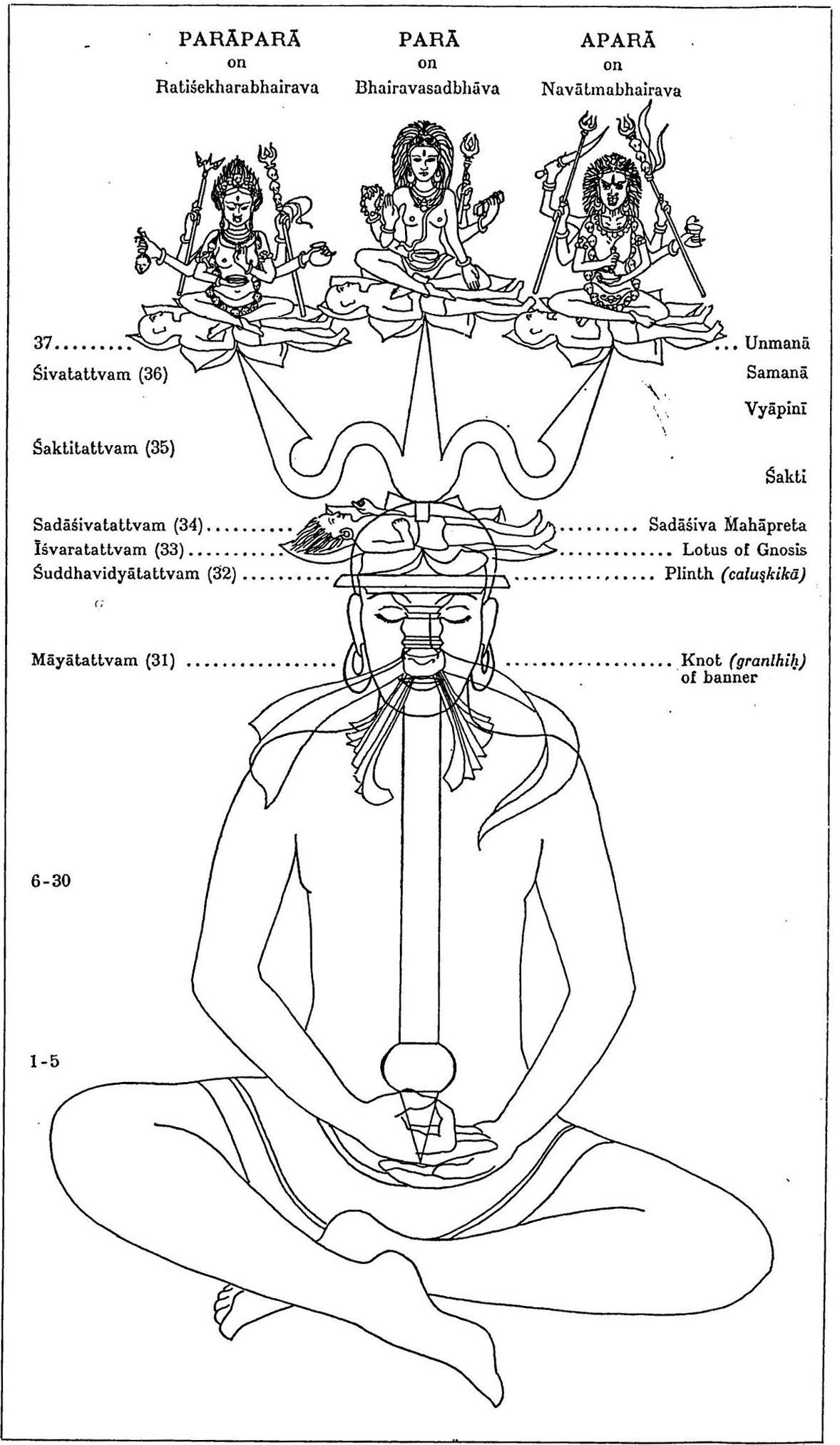
The image is a diagram from Kashmir Shaivism, a school of Hindu philosophy. It illustrates the concept of tattvas (principles of reality) and the three goddesses—Parā, Parāparā, and Aparā, who represent different aspects of divine energy (Śakti).
The three figures at the top of the diagram represent the Trika goddesses:
Parāparā (transcendent-immanent) sits on Ratiśekharabhairava.
Parā (supreme) sits on Bhairavasadbhāva.
Aparā (immanent) sits on Navātmabhairava.
These goddesses represent the three stages of Śakti (divine energy) and are central to the Trika system.
The numbers and labels on the left and right sides of the diagram refer to the 36 tattvas of Kashmir Shaivism, which are principles of reality that describe the descent of consciousness from the divine to the material world. The diagram shows the higher tattvas in the head region, with the lower tattvas extending down the body. The human figure in a meditative pose represents the practitioner, and the diagram illustrates the path of spiritual ascent through the tattvas to realize the ultimate reality of Śiva.
English Translations og Sanskrit terms in the image:
PARĀPARĀ: Supreme-unsupreme or transcendent-immanent
PARĀ: Supreme
APARĀ: Immanent
Ratiśekharabhairava: A form of Bhairava (a fierce manifestation of Śiva).
Bhairavasadbhāva: The essential nature of Bhairava.
Navātmabhairava: The nine-fold self of Bhairava.
Unmanā: Beyond mind.
Samanā: Equalized consciousness.
Vyāpinī: Pervasive.
Śivatattvam (36): The principle of Śiva.
Śaktitattvam (35): The principle of Śakti.
Śakti: Divine energy
Sadāśivatattvam (34): The principle of Sadāśiva.
Sadāśiva Mahāpreta: Great corpse of Sadāśiva.
Išvaratattvam (33): The principle of Īśvara.
Suddhavidyātattvam (32): The principle of pure knowledge.
Lotus of Gnosis: Lotus of knowledge.
Plinth (catuṣkikā): A four-sided base or pedestal.
Māyātattvam (31): The principle of Māyā (illusion).
Knot (granthih) of banner: A knot or bind.
0 Comments