
Bees and yellowjackets are essentially enemies: yellowjackets raid bee hives, and often kill and eat weaker members or members who are attempting to recover outside the hive. They also prey on males when these are ejected on mating day. Bees have specialized ‘guards’ that risk their lives to defend the hive entrance from yellow jackets. And these guards have to be extremely skillful, because, a yellow-jacket is vastly more well-armed and armored than a bee. Their mandibles are fierce, and they can sting many times. A bee has nearly no armor, and a single sting is its last. Bee mandibles are perhaps 1/10th as effective as weapons as those of a yellowjacket. The bee wasp-guards are incredibly skillful; they must eject a highly armed and armored invader without being bitten or stung, and without stinging. They have developed a sophisticated wrestling technique, whereby they fully engage the wasp, and bite at its wings and legs while evading both its mandibles and sting. They survive nearly all such encounters, and I have seen a single bee guardian repulse at least 7 wasps over an hour without sustaining any obvious injuries. Of course, the wasps are vastly overconfident, and relatively lazy. Once they have been bitten a few times, and have failed to inflict damage on the guard, they get the picture, so to speak, and depart. I noticed something the other day about tubular flowers. Most of the bees were visiting the open end of the flower, which is the common habit of the bee, which uses a slightly elongated ‘tongue’ to pull nectars from the flowers. The yellow-jackets, however, climb to the end of the flower, where it meets the stem, pierce it there with their mandibles, and directly extract nectar from the place in the flower where it is pooled. This is nearly an inch from the flower opening. I realized that the bees were at a vast disadvantage here; the ferocity of the wasps’ mandibles meant they could bite through the flower to get at the place where most of the available nectar is pooled. So, it would appear that the bees are getting ‘the short end of the stick’ in this arrangement. But as I mentioned previously, yellowjackets are relatively lazy; bees, on the other hand are extremely intelligent. Today as I observed bees working the flowers I had seen the wasps pierce, I noticed something surprising. They have realized that the wasps are piercing the flowers, and have thus learned to locate flowers thus pierced, and insert their tongues through these piercings to obtain nectar. Yellowjackets do not have anything resembling a bee’s tongue — so they can only obtain a tiny portion of nectar for each flower they pierce. Bees, on the other hand, can take as much as they can pull out through the piercing. So there is at least one way in which bees can take advantage of the activity of one of their fiercest foes: by finding flowers they have pierced, and using their tongues to extract nectar from the central pool, instead of the out edges where, one imagines, there is relatively little to be had.
Bees and yellowjackets are essentially enemies: yellowjackets raid bee hives, and often kill and eat weaker members or members who are attempting to recover outside the hive. They also prey on males when these are ejected on mating day. Bees have specialized ‘guards’ that risk their lives to defend the hive entrance from yellow jackets. And these guards have to be extremely skillful, because, a yellow-jacket is vastly more well-armed and armored than a bee. Their mandibles are fierce, and they can sting many times. A bee has nearly no armor, and a single sting is its last. Bee mandibles are perhaps 1/10th as effective as weapons as those of a yellowjacket.
The bee wasp-guards are incredibly skillful; they must eject a highly armed and armored invader without being bitten or stung, and without stinging. They have developed a sophisticated wrestling technique, whereby they fully engage the wasp, and bite at its wings and legs while evading both its mandibles and sting. They survive nearly all such encounters, and I have seen a single bee guardian repulse at least 7 wasps over an hour without sustaining any obvious injuries. Of course, the wasps are vastly overconfident, and relatively lazy. Once they have been bitten a few times, and have failed to inflict damage on the guard, they get the picture, so to speak, and depart.
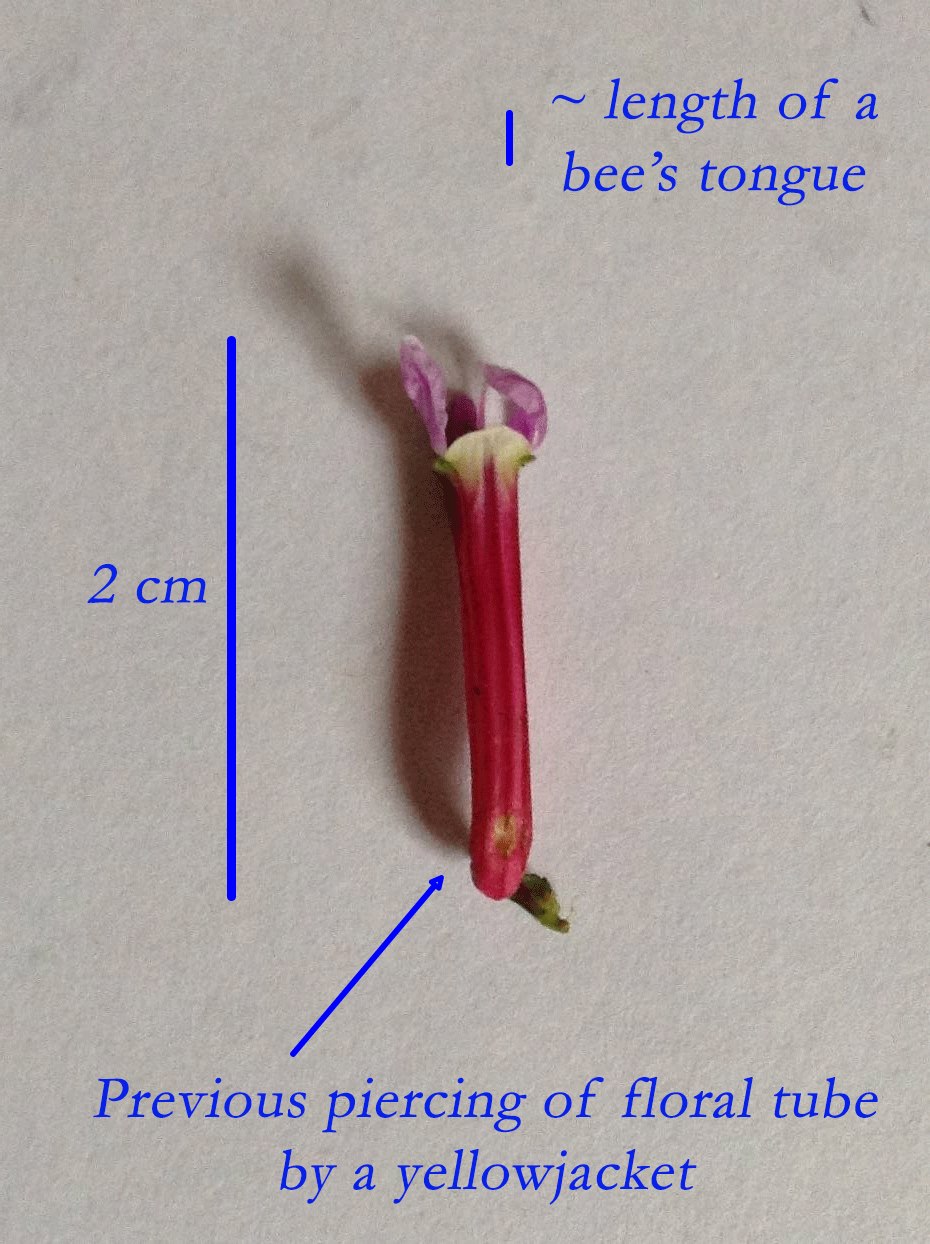
I noticed something the other day about tubular flowers. Most of the bees were visiting the open end of the flower, which is the common habit of the bee, which uses a slightly elongated ‘tongue’ to pull nectars from the flowers. The yellow-jackets, however, climb to the end of the flower, where it meets the stem, pierce it there with their mandibles, and directly extract nectar from the place in the flower where it is pooled. This is nearly an inch from the flower opening.
I realized that the bees were at a vast disadvantage here; the ferocity of the wasps’ mandibles meant they could bite through the flower to get at the place where most of the available nectar is pooled. So, it would appear that the bees are getting ‘the short end of the stick’ in this arrangement.
But as I mentioned previously, yellowjackets are relatively lazy; bees, on the other hand are extremely intelligent. Today as I observed bees working the flowers I had seen the wasps pierce, I noticed something surprising.
They have realized that the wasps are piercing the flowers, and have thus learned to locate flowers thus pierced, and insert their tongues through these piercings to obtain nectar. Yellowjackets do not have anything resembling a bee’s tongue — so they can only obtain a tiny portion of nectar for each flower they pierce. Bees, on the other hand, can take as much as they can pull out through the piercing. So there is at least one way in which bees can take advantage of the activity of one of their fiercest foes: by finding flowers they have pierced, and using their tongues to extract nectar from the central pool, instead of the out edges where, one imagines, there is relatively little to be had.
0 Comments