
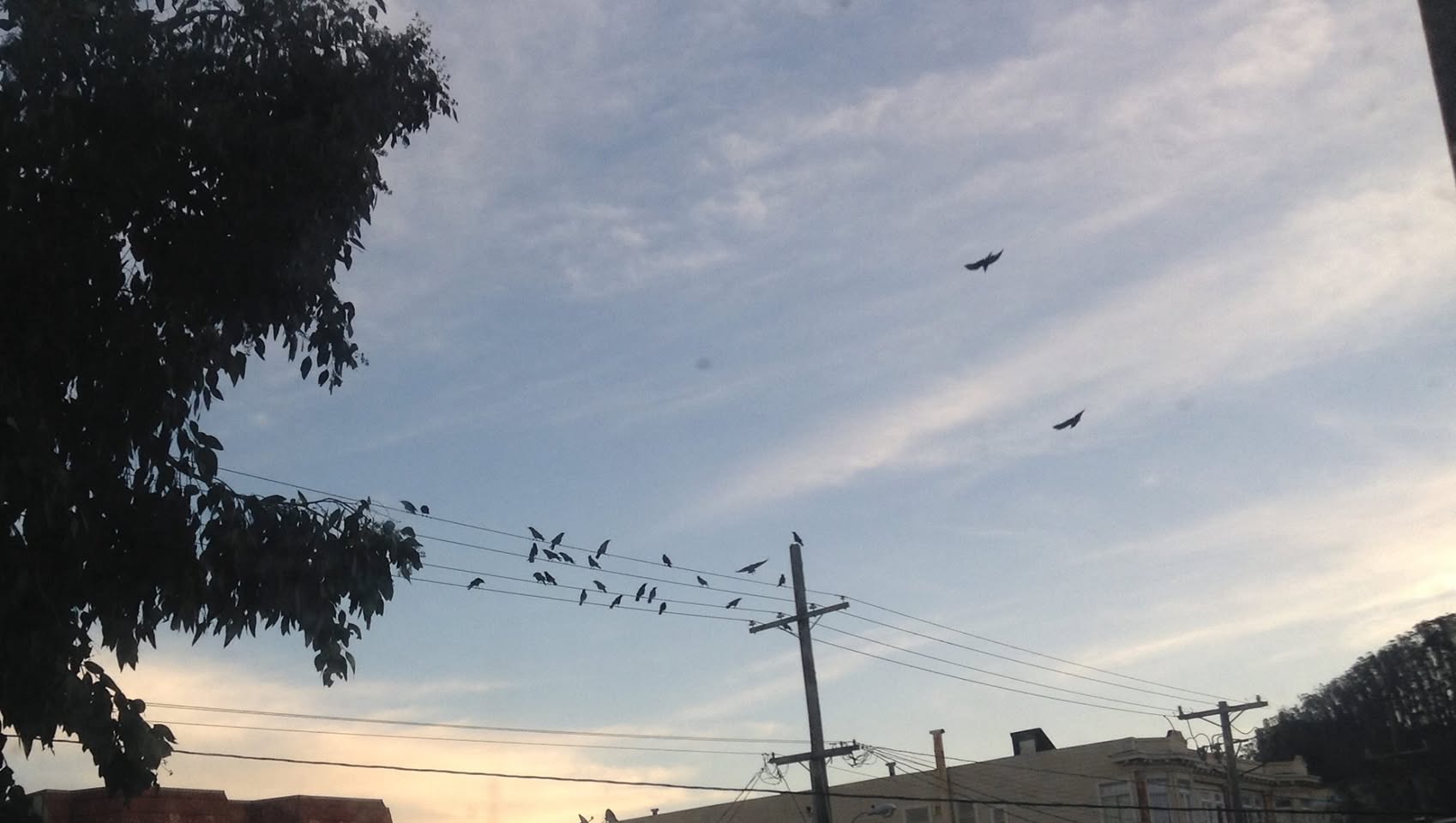
Crows in the evening, and a couple of ravens.
Phenology Notes:
Phenology has a range of applicable meanings that span the interval between rigourously academic orientations and those of intimate relational communion among species and living places in time. Essentially, however, the term refers to intimacy with the myriadly ‘streamed’ dimensions of living time over the lunar cycles, which divide the solar year into 12 or 13 ‘pulses’. Phenology is the observation of and participation in each cycle in a specific living place, over the 12 or 13 pulses of the moon. Thus it is a way of understanding a living calendar with myriad ‘organs’ and extensions, and a way of directly participating in many of these relationships and becoming ‘remembered’ to and of them.
Everyone can participate in learning features of the phenological history and moment of places they live, and even those they may visit. Each place has unique participants, but there is an overall process and character that can be understood somewhat like a template that differs according to distinct kinds of ecologies and geographical locations.
Although I had developed a ‘feral’ awareness of these matters, it was disorganized until I was introduced to the more formal concept by my friend Ryan HeavyHead, who, for many years, taught phenology at Red Crow College in Lethebridge, Alberta. This college was recently destroyed.
Phenology is the study and relation with the various orders of living time in nature, by direct personal exploration, observation, relation and sensing. It can be more or less a science, based on a lot of accounting, or it can be an art, of learning the living languages of the plant, animal and insect peoples and of the living places themselves.
Here are a few recent phenological observations I have made as we enter what I can only still refer to as ‘just before the onset’ of ‘The Eagle Moon’, which begins with the first appearance of the sliver after the new moon. This moon is so-named because it is the moon during which Eagles and Owls usually found their nests, and this indicates a vast array of other events that generally occur at or near this time.
02.07: Bumblebee queens are nest scouting. They must have awakened from hibernation relatively recently. I have seen no wasp queens yet.
02.08: Snow geese behavior now includes a lot more vocalization and a ‘low-necked running’ display that appears to be related to mating. More Bumblebee scouting. A ladybird beetle indicates the succession of the ladybird molt sometime recently.
02.09: Crows are exhibiting a peculiar grouping and agitation behavior. 7-20 crows, with others riding updrafts 300 ft up above them, are agitating wildly all around the neighborhood. There is no sign of hawks or eagles. Some displays result in brief combat where birds actually attach to each other and fall from the perch in physical contest. I am confused. I do not yet understand what this behavior signifies or embodies. I hear it proceeding for hours, and clearly the groups are circling the neighborhood where there is rarely any activity that is not the 4-crow family, except briefly in the evenings or when groups of crows ride the updrafts of the nearby small mountain in spirals. I have never seen this activity before, and groups in daytime are uncommon.
02.10: From almost before dawn the clear cries of the group of crows begin and proceed again in similar fashion to what I witnessed yesterday, however it is slightly less agitated and severe. After a few glimpses of the murder, they alight on a nearby telephone wire system and I can get a clear look at the entire party and the activity. I begin to link events I have witnessed and am aware of, remembering that this is a time when many birds are in the pre-processes that will become mating (including selection if appropriate), nest competition and selection, brood rearing, fledging and all that lies beyond. It now seems clear that this group is probably all or nearly all males. And what is happening is profound.
For the past two days, they have, as a group, been at once competing and cooperating to momentously exemplify their excellence, as crow males, as warriors, as protectors, as vigilant and powerful mates. This they seem to do as a group, and within the group there is often competition when two birds are ‘too close’ to each other in … their embodiment and presentation of the ‘assets’ of their animal and spirit nature. This does not seem to be like a ceremony’, since only humans would have the second-order representation — rather it seems to be the pure, unnamable embodiment of what ceremonies are representations of — the announcement of the beginning of the entire process, and the males are fiercely injecting their spirit into the entire process, the atmosphere itself, time, each roosting tree… everywhere. This is not ‘a display’, but instead the sacred and active accomplishment of a necessity. The men ‘are bringing forth the spirits and powers of this time and the mating way’. They ‘summon and invoke them’, directly, nobly, and truly — or so it presently seems to my sense and speculations.
The most local Bumblebee queen is still seeking for a nesting place.
At the pond: the Snow Geese are gone from the pond. The mallard couple appears to be already nesting. I saw a Bumblebee queen founding a nest, and solved the missing gopher mystery; they are still there, just no longer out in the open. One of the evergreen trees with needles was laden with pollens to the degree that I could have literally harvested an ounce of pollen from this tree.
The next day and the following days the geese are still at the pond. The mallard couple ranges over a few ponds in the garden, and probably have a night nesting spot (there are sometimes coyotes in the garden at night).
0 Comments